Choosing the right Serbia eVisa C visa vs D visa depends on your planned stay duration. Serbia’s Visa C permits short stays up to 90 days for tourism or business, while Visa D covers 90 to 180 days for work or study. UK citizens enjoy visa-free entry for up to 90 days but must apply for Visa D for longer stays or employment. Both visas require a passport valid at least 90 days after intended departure, a 3.5 x 4.5 cm photo, and valid travel medical insurance.
Do UK Citizens Need a Visa for Serbia in 2026?
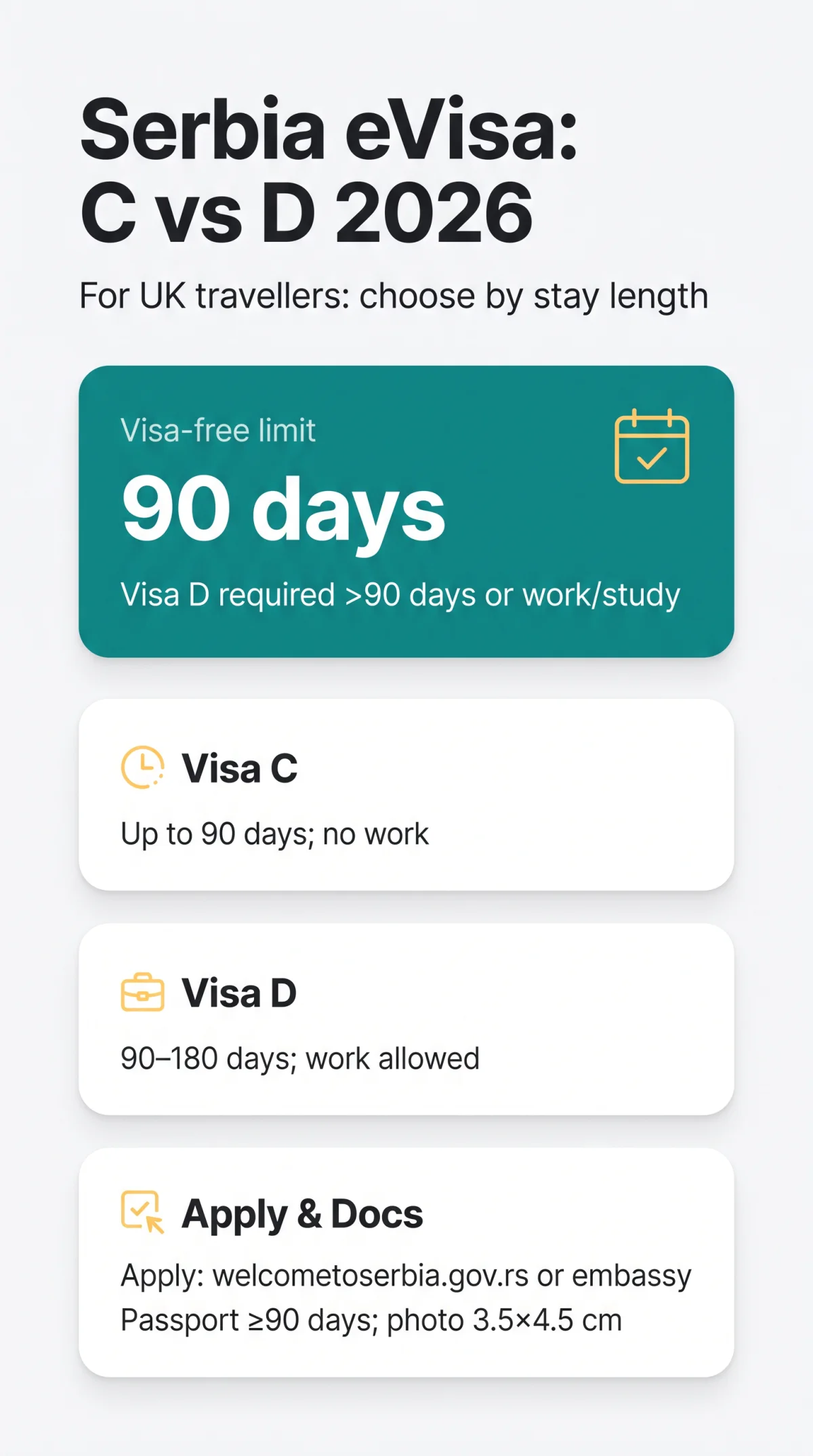
UK passport holders enter Serbia visa-free for up to 90 days within any 180-day period but require Visa D for stays exceeding 90 days or any work and study activity.
Visa-free access covers only tourism and short business trips, making the C vs D distinction crucial for UK travellers. Anyone planning employment, study, or family reunification must apply for Visa D regardless of British passport privileges.
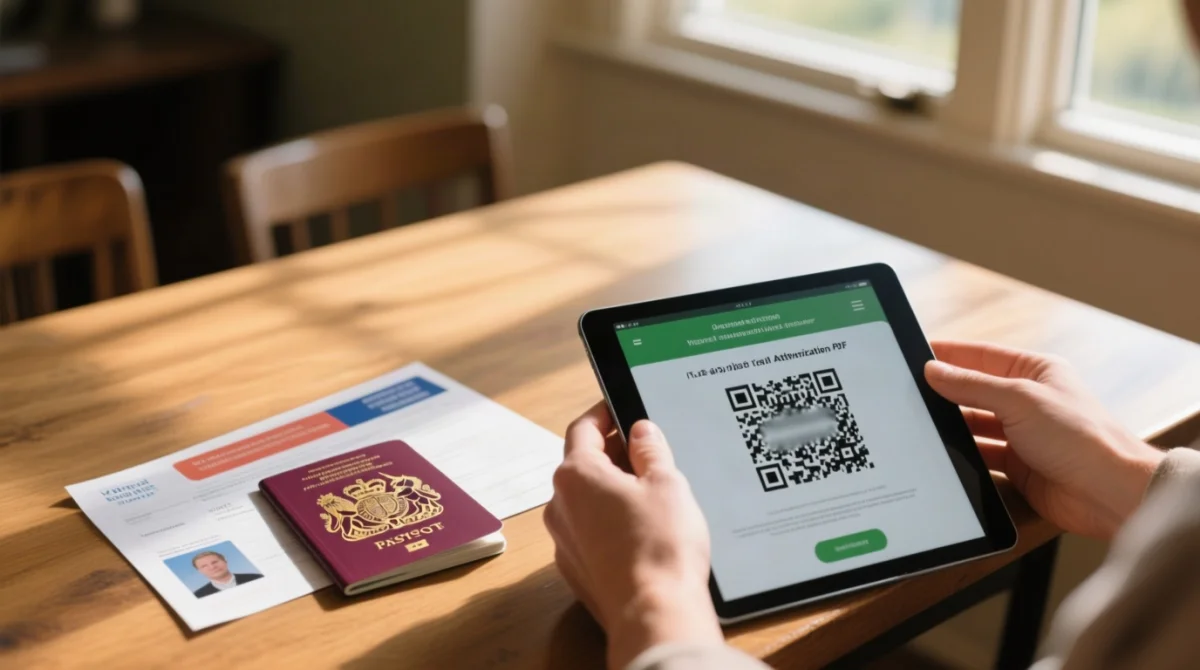
Since 23 April 2025, Serbia has issued a Digital Travel Authorization to nationals of 46 countries who normally require a visa. This electronic PDF document includes security features and QR codes for border verification, offering a faster alternative to the traditional visa sticker for eligible applicants.
Holders of a valid multiple-entry Schengen, UK, or US visa may also enter Serbia visa-free for up to 90 days within a 180-day period, provided the visa remains valid for the entire stay. This substitute visa scheme, adopted on 30 October 2014, simplifies short visits but does not grant work or study rights.
EU and EEA citizens likewise enjoy visa-free entry for up to 90 days within any 180-day period and may present a national ID card in lieu of a passport. The Serbia Visa C and Visa D comparison confirms that UK citizens need no visa for holidays under 90 days, yet Visa D remains mandatory for longer or purpose-specific stays.
What Is a Short-Stay Visa C?
Serbia’s Visa C allows single, double, or multiple entries for up to 90 days within a 180-day period for tourism, business, transit, or medical purposes, with no right to work or study.
The Serbia Visa C and Visa D comparison shows that Visa C is relevant for UK travellers primarily in substitute-visa or transit contexts, since visa-free access already covers standard tourist and business trips under 90 days. Visa C may be issued as a single-entry, double-entry, or multiple-entry permit, with multiple-entry visas valid for up to 1 year. Permitted purposes include tourism, private visits, business meetings, cultural activities, medical tours, and transit.
Visa C applications can be submitted online via the eApplications portal at welcometoserbia.gov.rs or in person at a Serbian diplomatic-consular mission. Online submission requires an eID account registered at eid.gov.rs and is processed upon payment of the visa fee.
What Is a Long-Stay Visa D?
Visa D permits stays of 90 to 180 days for employment, education, investment, family reunification, religious service, medical treatment, or seasonal work, and serves as the gateway to a temporary residence permit.
The Serbia Visa C and Visa D comparison highlights that Visa D is required even for visa-exempt nationalities when the stay exceeds 90 days. Visa D allows multiple entries and, on the employment ground, functions as both a visa and a work permit, enabling the holder to start working immediately upon arrival. Under Serbia’s Law on Foreigners and Law on Employment of Foreigners (referenced on welcometoserbia.gov.rs), Visa D holders may apply for a temporary residence permit while the D visa remains valid.
Visa D Grounds: Complete List of Eligible Purposes
Serbia’s Visa D is issued on eight legal grounds, each requiring specific documents and proof of financial means:
- Employment: Working for a Serbian-located business; seasonal employment; training or professional development. Allows holder to start working immediately upon arrival.
- Education: Higher education, language courses, long-term internships.
- Investment: Founder of a legal or physical entity providing economic benefit to Serbia.
- Family reunification: First-degree family member of a Serbian citizen, typically a spouse.
- Religious service: Serving at a religious institution in Serbia.
- Medical treatment: Long-term treatment at a Serbian medical institution.
- Seasonal jobs: Short-term seasonal employment.
- Other: Academic, researcher, or scientist at a certified research centre.
Serbia eVisa C Visa vs D Visa: Key Differences
The Serbia eVisa C visa vs D visa comparison shows that Visa C covers short stays of up to 90 days within a 180-day period with no work or study rights, while Visa D covers 90 to 180 days, allows employment from day one, and leads to a temporary residence permit.
| Parameter | Visa C (Short-Stay) | Visa D (Long-Stay) |
|---|---|---|
| Duration | Up to 90 days in 180-day period | 90 to 180 days |
| Purpose | Tourism, transit, business meetings, private visits, medical tours | Employment, education, investment, family reunification, religious service, medical treatment, seasonal jobs, other |
| Work rights | No employment or study permitted | Employment allowed from arrival; also functions as work permit |
| Entries | Single, double, or multiple | Multiple entries |
| Fees | See MFA fee schedule at welcometoserbia.gov.rs | Higher than Visa C; varies by ground |
| Processing time | 5 to 21 working days | 1 to 3 months (employment ground) |
| Residence pathway | None | Temporary residence permit up to 3 years |
| Application channel | Online via welcometoserbia.gov.rs or embassy | Online via welcometoserbia.gov.rs or embassy |
| UK requirement | Not needed (visa-free up to 90 days) | Required for stays over 90 days or any work/study |
| Financial proof | €50 per day of stay | Ground-specific; exceeds €50/day threshold |
Visa D applications must be submitted at least 3 months before travel and are required even for visa-exempt nationalities staying over 90 days.
Visa Fees and Financial Proof in 2026
The Serbia Visa C and Visa D comparison shows that Visa D application fees are higher than Visa C fees, though exact EUR/RSD amounts are not published in any available source. Applicants must verify current costs on the Serbian MFA fee schedule at welcometoserbia.gov.rs.
Both visa types require online payment upon submission of the eApplication through the e-portal; the specific payment gateway is not specified in available sources. Fee refund terms in case of refusal or withdrawal are likewise not published, so applicants should confirm these details with the relevant diplomatic-consular mission before applying. Expedited or priority processing availability has not been confirmed in any source; contact the nearest Serbian consulate for current options.
Financial Proof: Short-Stay vs Long-Stay
The Serbia Visa C and Visa D comparison diverges on financial proof. Visa C applicants must demonstrate €50 per each day of stay, supported by a bank statement or equivalent cash. Visa D financial requirements are not uniformly specified and depend on the ground of issuance: employment-based applicants rely on employer guarantees, investment-ground applicants provide investment documentation, and family-reunification applicants may rely on a sponsor’s financial responsibility statement.
Eligibility Criteria and Required Documents
The Serbia Visa C and Visa D comparison shows that both categories require a passport valid at least 90 days after intended departure from Serbia, with at least 2 consecutive blank pages, issued within the past 10 years, a 3.5 x 4.5 cm photo, valid travel medical insurance, and a completed application form. Visa D adds ground-specific documents depending on the purpose of stay.
Passport and Photo Requirements
Passport validity must be at least 90 days past intended departure from Serbia, with 2 consecutive blank pages, and issued within the past 10 years. The required photo size is 3.5 x 4.5 cm for all applicants. Non-Serbian certificates submitted with Visa D applications may require a Hague Apostille and certified sworn translation into Serbian.
Invitation Letter: What It Must Include
Certified invitation letters for private visits under both Visa C and Visa D must contain the inviter’s full identity details (first and last name, date of birth, citizenship, phone number, residential address), the applicant’s passport data, a signed financial responsibility statement covering stay and removal costs, and certification by the competent document verification authority of the Republic of Serbia.
For minors under 18 travelling without both parents, parental consent is required in Serbian or English, verified through the applicant’s national Ministry of Foreign Affairs.
Processing Times and Application Steps
The Serbia Visa C and Visa D comparison shows that Visa C consular stickers take 5 to 21 working days, while Visa D employment applications take 1 to 3 months after submission of all required documents. Serbia recommends submitting Visa D applications at least 3 months before travel.
| Visa Type / Ground | Processing Time |
|---|---|
| Visa C (consular sticker) | 5 to 21 working days |
| Visa C (Digital Travel Authorization) | Not separately published; expected faster than sticker |
| Visa D (employment) | 1 to 3 months |
| Visa D (other grounds) | Varies; apply at least 3 months before travel |
Step-by-Step Online Application
Register an eID account
Create your eID account at eid.gov.rs.
Complete the digital form
Fill in the application on the eVisa portal at welcometoserbia.gov.rs.
Upload required documents
Attach all necessary documents – do not staple them.
Pay the visa fee online
Complete the online payment upon submission of the eApplication.
Receive your electronic visa
Get an electronic visa or Digital Travel Authorization as a PDF with QR codes.
Applications with stapled documents are rejected, and incomplete submissions will not be accepted.
Applying at a Serbian Embassy or Consulate
In-person applicants book an embassy appointment, submit a complete unstapled document set, provide biometrics, pay the consular fee, and collect the passport with the affixed visa sticker. Arriving late for a consular appointment results in denied access and the need to book a new appointment.
The Serbia Visa C and Visa D comparison advises UK travellers to apply early during peak season (July to September), when consular processing may take longer than the standard timeframe.
Required Documents Checklist
Common documents for both Visa C and Visa D include a valid passport, 3.5 x 4.5 cm photo, completed application form, travel medical insurance, and proof of fee payment. The Serbia Visa C and Visa D comparison adds ground-specific requirements for Visa D:
- Passport: Valid at least 90 days past departure, 2 blank pages, issued within 10 years (both Visa C and Visa D).
- Photo: 3.5 x 4.5 cm format for all applicants.
- Travel medical insurance: Valid for the entire duration of stay.
- Visa D: Employment: Employment contract, police confirmation of no criminal record, satisfactory medical examination.
- Visa D: Family reunification: Certified invitation letter from spouse, marriage certificate not older than 6 months.
- Visa D: Education: Enrollment confirmation from a Serbian educational institution.
- Certified invitation letter (both C and D, private visits): Must include inviter’s full identity details, applicant’s passport data, a signed financial responsibility statement covering stay and removal costs, and certification by the competent document verification authority of the Republic of Serbia.
- Minors under 18: Parental consent in Serbian or English when not accompanied by both parents.
Full document requirements are published at welcometoserbia.gov.rs.
Which Visa Do You Need? UK Decision Scenarios
The Serbia Visa C and Visa D comparison shows that UK travellers staying 90 days or less without working need no visa, but stays exceeding 90 days or any employment, study, or family-reunification purpose always require Visa D.
UK passport holders enjoy visa-free access for up to 90 days within any 180-day period. Five common scenarios illustrate where the distinction matters:
- Two-week holiday: No visa required. Standard tourism falls under visa-free access.
- Four-month work assignment: Visa D on the employment ground. It functions as both visa and work permit, allowing the holder to start working immediately upon arrival.
- Digital nomad for three months: Grey area. Visa-free entry covers the duration, but Visa C grants no right to work, and remote employment may require Visa D. Consult the nearest Serbian consulate for guidance on remote work classification.
- Marrying a Serbian citizen: Visa D on the family-reunification ground, requiring a certified invitation letter and a marriage certificate not older than six months.
- Six-month university course: Visa D on the education ground, requiring enrollment confirmation from a Serbian educational institution.
Residence Pathways and Mistakes to Avoid
The Serbia Visa C and Visa D comparison shows that Visa D holders may apply for a temporary residence permit valid up to 3 years while the D visa remains valid, whereas Visa C holders have no residence pathway and generally cannot convert to Visa D from within Serbia.
The residence permit must be sought on the same legal grounds as the original Visa D. After 3 years of continuous temporary residence, the holder becomes eligible for permanent residence. Serbia introduced a unified residence and work permit on 1 February 2024 and aims to align its visa policy with the EU by the end of 2026. Switching from Visa C to Visa D inside Serbia is not a supported route; applicants must pursue the Visa D pathway from abroad, as outlined on welcometoserbia.gov.rs.
Several procedural pitfalls trigger automatic rejection. Incomplete submissions will not be accepted, and applications with stapled documents are rejected outright. Arriving late for a consular appointment results in denied access and the need to book a new appointment. No visa-on-arrival facility exists at Serbian borders, so travellers must secure the correct authorisation before departure. Overstaying a Serbia visa or the 90-day visa-free limit can result in fines, deportation, and an entry ban, and may negatively impact future Schengen visa applications.
Author’s note: This article was last fact-checked on 15 September 2026 against the Serbian MFA portal at welcometoserbia.gov.rs. This is an informational travel portal, not affiliated with the Serbian government. Visa rules change; always verify current requirements before applying.
FAQ
What is the difference between a C and D visa for Serbia?
Serbia’s Visa C permits short stays up to 90 days within a 180-day period for tourism, business, or transit, with no right to work or study. Visa D allows stays of 90 to 180 days for employment, education, or family reunification, and serves as a gateway to a temporary residence permit.
Do UK passport holders need a visa for Serbia in 2026?
UK citizens can enter Serbia visa-free for up to 90 days within any 180-day period for tourism or business. A Visa D is always required for stays exceeding 90 days or for any employment, study, or family reunification purposes in Serbia.
How much does a Serbia visa cost in 2026?
Exact EUR or RSD visa fee amounts for Serbia’s Visa C and Visa D are not available from standard sources. Applicants must consult the Serbian Ministry of Foreign Affairs fee schedule published at welcometoserbia.gov.rs to verify current application costs and payment methods.
How long does it take to get a Serbia visa?
Visa C consular stickers typically take 5 to 21 working days, while Visa D for employment takes 1 to 3 months after submitting all required documents. Serbia recommends submitting Visa D applications at least 3 months before travel.
Can I work in Serbia on a Visa C?
No, Serbia’s Visa C does not permit employment or study. You must apply for a Visa D on employment grounds, which functions as both a visa and a work permit, allowing you to start working immediately upon arrival.
What happens if I overstay my Serbia visa?
Overstaying a Serbia visa or the 90-day visa-free limit can result in fines, deportation, and an entry ban. It may also negatively impact future Schengen visa applications. Always ensure your stay complies with the permitted duration of your specific visa category.
Can I apply for a Serbia eVisa from the UK online?
Yes, both Visa C and Visa D can be applied for online via the welcometoserbia.gov.rs portal. Applicants must first register an eID account at eid.gov.rs, complete the digital form, upload documents, pay the fee, and receive an electronic visa or Digital Travel Authorization as a PDF.
Can I enter Serbia with a valid Schengen or UK multiple-entry visa?
Yes, holders of valid multiple-entry Schengen, UK, EU, or US visas can enter Serbia visa-free for up to 90 days within a 180-day period. The multiple-entry visa must remain valid for the entire duration of your stay in Serbia.
Can I switch from Visa C to Visa D while in Serbia?
Switching from a Visa C to a Visa D from within Serbia is generally not permitted. If you need to stay longer or change your purpose to work or study, you typically must leave Serbia and apply for the appropriate Visa D from abroad.
What documents do I need for a Serbia Visa D application?
Required documents include a valid passport, a 3.5 x 4.5 cm photo, completed form, travel medical insurance, and proof of fee payment. Visa D also requires ground-specific documents, such as an employment contract, enrollment confirmation, or a certified marriage certificate.
What should I do if my Serbia visa is refused?
You have the right to appeal to the Ministry of Foreign Affairs. Contact the nearest Serbian diplomatic-consular mission for the current appeals procedure and deadline, as these details are not published on the standard eVisa portal. Include any missing or corrected documents to strengthen your appeal.