
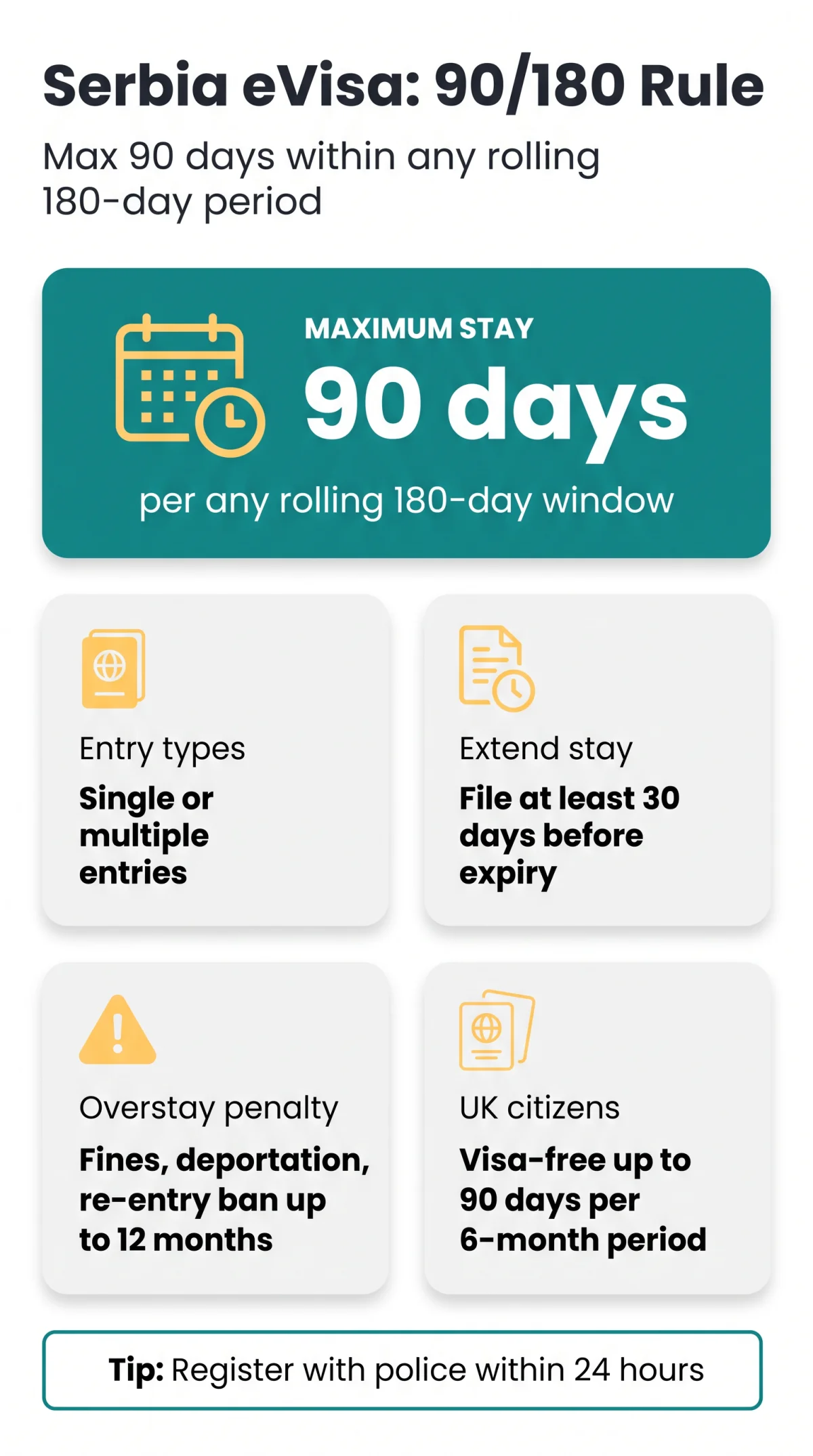
The serbia evisa duration of stay permits a maximum of 90 days within any rolling 180-day period. Both single-entry and multiple-entry eVisas enforce this cumulative limit. Extensions are possible only under narrow statutory grounds and must be filed at least 30 days before the permitted stay expires.
Visa validity is the entry window; duration of stay is the number of days you may spend inside Serbia. Overstaying risks fines, deportation, and a re-entry ban of up to 12 months.
UK citizens with a full British citizen passport may enter Serbia visa-free for up to 90 days within a 6-month period for business or tourism, meaning an eVisa is not mandatory for them.
Published: 15 September 2026. Rules verified against Serbian MUP guidance and gov.uk travel advice.
Understanding Your Serbia eVisa: Validity vs Duration of Stay
A Serbia eVisa allows up to 90 days within any rolling 180-day period; visa validity and duration of stay are separate limits.
The Serbia eVisa duration of stay permits a maximum of 90 days within any rolling 180-day window, counted from the date of first entry. Validity (entry window) differs from duration (days inside Serbia). Cumulative presence across visits counts toward the same 90-day threshold.
Example: enter Serbia on 1 June for 40 days (until 10 July). On re-entry on 1 August, only 50 days remain available until 28 October, because the 180-day window counts backward from each day of presence and never resets upon exit.
UK citizens are visa-free for 90 days per 6-month period for business or tourism; eVisa not required. The Schengen short-stay calculator at travel.europa.eu uses the same 90/180 logic. Mapping each entry and exit date on a calendar is the only reliable method to track cumulative stay across multiple visits.
Single-Entry vs Multiple-Entry eVisa: What’s the Difference?
A single-entry Serbia eVisa allows one entry within its validity window; a multiple-entry eVisa permits repeated entries, but the 90/180-day cumulative stay limit applies to both.
The Serbia eVisa duration of stay enforces the same 90 days within any rolling 180-day period regardless of entry type. The difference is the number of permitted border crossings. Serbian short-stay visas (C visa) are issued as one entry, two entries, or multiple entries, per the Serbian government visa portal at welcometoserbia.gov.rs.
| Type | Validity Window | Entries | Max Stay Per Visit | Best For |
|---|---|---|---|---|
| Single-entry | Typically 90 days from issuance | 1 | Up to 90 days (within 180-day rolling window) | One-way trips to Serbia with no border crossings |
| Multiple-entry | Up to 12 months | Multiple | Up to 90 days cumulative (within 180-day rolling window) | Balkan multi-country itineraries with re-entry to Serbia |
Choose multiple-entry for Balkan multi-country itineraries; the 90/180-day limit is cumulative across all entries.
Can You Extend Your Stay Beyond 90 Days?
The Serbia eVisa duration of stay may be extended only under specific statutory grounds and requires filing at a local MUP police station at least 30 days before the permitted stay expires.
Under Article 15 of the Serbian Foreigners Act (Zakon o strancima, Official Gazette RS No. 24/2018 with amendments), the Serbia eVisa duration of stay can be extended under narrow grounds: medical emergency, force majeure, humanitarian reasons, or unexpected personal circumstances. Travellers must submit the application at the local police commissariat where they registered, no later than 30 days before the current stay expires. An administrative fee applies per the MUP tariff (exact amount set by the local police directorate; confirm at station before filing). Processing typically takes several weeks. If approved, up to 30 additional days may be granted; if denied, you must depart immediately.
Required documents include:
- Valid passport
- Completed extension application form
- Medical certificate or evidence supporting the statutory ground
- Proof of financial means
- Proof of accommodation
- White card (police registration slip)
- Proof of fee payment
Need to Stay Longer? The D Visa and Temporary Residence Permit Pathway
A D visa allows stays of 90 to 180 days and serves as the prerequisite for a Temporary Residence Permit valid up to 3 years.
The Serbia eVisa (C visa) cannot be converted into long-term residency, as explained in our Visa C vs Visa D comparison. For stays beyond the Serbia eVisa duration of stay extension limit, a D visa (90 to 180 days, multiple entries) serves as the pathway to a Temporary Residence Permit valid for up to 3 years, applied for while the D visa remains valid. D visa applications require at least 3 months advance notice and can be submitted at a Serbian embassy or consulate. Permitted purposes include employment, education, family reunification, investor status, religious service, medical treatment, and seasonal jobs. The simplified pathway is: C visa to D visa to TRP to permanent residence. Further details are available on the Serbian government portal welcometoserbia.gov.rs and the UK Government’s travel advice at gov.uk.
Serbia eVisa Validity Window and Online Application Process
A Serbia eVisa is typically valid for entry within 90 to 180 days of issuance; apply through the online portal at least 15 business days before travel.
The Serbia eVisa duration of stay begins only upon entry, but the visa itself has a finite validity window after issuance. If you do not enter Serbia within that window, the eVisa lapses and a new application is required. You may submit an application no earlier than 3 months before your planned travel date. For step-by-step instructions, consult our complete online application guide.
Visit the eApplications portal
Go to welcometoserbia.gov.rs and access the eApplications portal.
Create a registered account
Register on eid.gov.rs (Electronic Identification Portal).
Complete the application form
Fill in the form and upload all required documents.
Pay the visa fee and submit
Pay the visa fee and submit the application.
Receive your eVisa
Receive your eVisa as a PDF with security features and QR codes.
Since 23 April 2025, Serbia issues the eVisa as a Digital Travel Authorization, a PDF with QR codes available to citizens of 46 countries. Standard processing takes 5 to 21 working days; embassy or consulate applications take 7 to 10 business days. Print a hard copy as backup alongside the digital version. The Serbia eVisa cannot be applied for from within Serbia; all applications must be submitted before arrival.
Documents Required for Your Serbia eVisa Application
Applicants need a passport valid 90+ days past departure, travel insurance covering medical emergencies, proof of accommodation, and evidence of financial means.
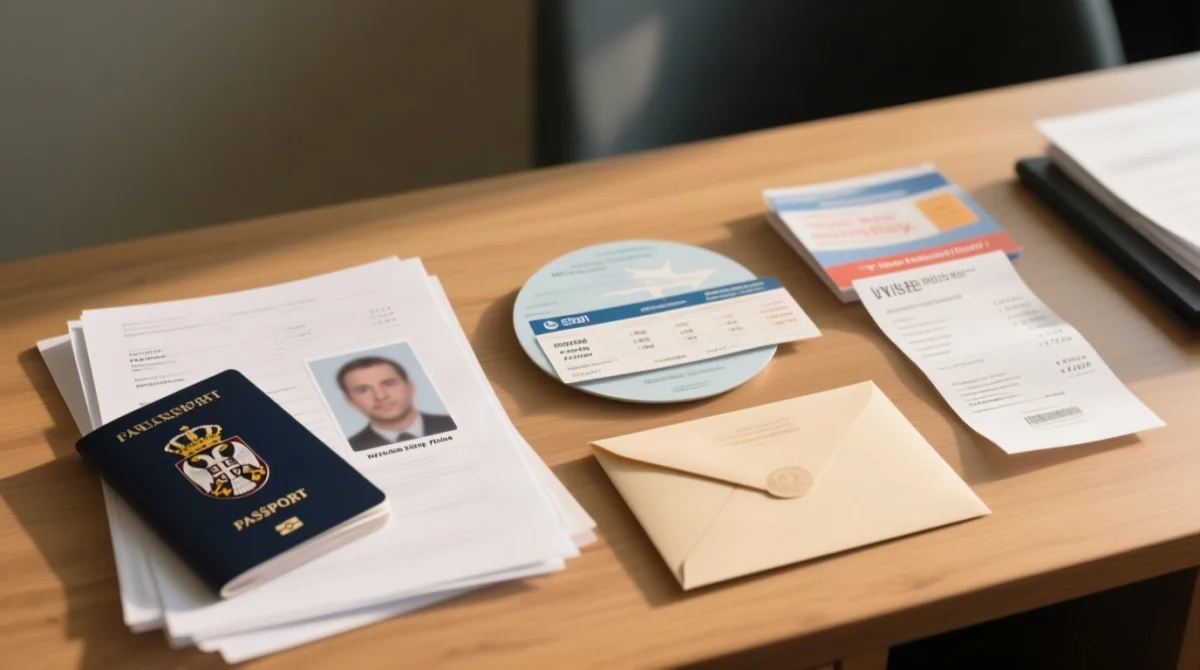
The Serbia eVisa duration of stay depends on a complete application. Provide every item from our Serbia eVisa documents checklist below before initiating your request through the eApplications portal:
- Passport – valid for at least 90 days after intended departure, issued within the previous 10 years, with a minimum of 2 consecutive blank pages.
- Digital photograph – meeting ICAO biometric standards.
- Proof of accommodation – hotel booking, rental agreement, or itinerary from a travel agency.
- Round-trip or onward travel itinerary.
- Proof of financial means – recent bank statements covering living costs during your intended stay.
- Travel medical insurance – mandatory, must be adequate and valid for the duration of your visit.
- Visa fee payment confirmation.
- For private visits – an invitation letter verified by the competent Serbian authority, including the visitor’s travel document details and reason for visit.
After Arrival: Registration, Overstay Penalties, and the 90-Day Clock
Register with police within 24 hours of arrival; overstaying a Serbia eVisa risks fines and a re-entry ban of up to 12 months, and leaving Serbia does not reset the 90-day counter.
The Serbia eVisa duration of stay requires every visitor to register at a local police station within 24 hours of arrival. Hotels handle this automatically for their guests; travellers staying in private accommodation must self-register. Keep the white card (registration slip) issued by police, as you will need it for departure and any extension application. Failure to register carries a fine, arrest, and court appearance per gov.uk.
Border guards must stamp your passport on arrival. Departing without an entry stamp triggers illegal immigration charges, a heavy fine, and a potential prison sentence. The Serbia eVisa duration of stay enforces a 90/180-day rolling rule: exiting and re-entering Serbia does NOT reset the counter.
Overstay penalties under the Foreigners Act include fines (set at MUP discretion based on overstay duration), a re-entry ban of up to 12 months for prolonged or repeated overstays, and potential criminal liability. Serbian law provides no formal grace period after the permitted stay expires.
Frequently Asked Questions about Serbia eVisa Duration of Stay
How do I calculate my remaining days under the 90/180 rule?
Count all days spent in Serbia within any rolling 180-day window. Use the Schengen short-stay calculator at travel.europa.eu as a cross-reference.
Can I apply for a Serbian eVisa while already in Serbia?
No. You must apply from outside Serbia through the online portal. For longer stays, explore the in-country extension process at your local MUP police station or apply for a D visa through a Serbian embassy abroad.
Do UK passport holders need an eVisa for Serbia?
No. UK citizens with a full British citizen passport may enter Serbia visa-free for up to 90 days within a 6-month period for business or tourism.
Is there a grace period after my Serbia eVisa expires?
No. Serbian law does not formally provide a grace period. You must depart before your permitted stay ends to avoid fines and potential re-entry bans.
Does a visa run to Montenegro and back reset my 90-day counter?
No. The 180-day window is rolling; time outside Serbia counts toward it. Maximum 90 days across all visits within any 180-day period.
What documents do I need for an in-country extension?
Passport, completed extension form, supporting evidence (e.g., medical certificate), proof of financial means, accommodation proof, white card (registration slip), and proof of fee payment.
What is the Serbia Digital Travel Authorization?
The Digital Travel Authorization is the electronic format of the Serbia eVisa, launched on 23 April 2025. It is issued as a PDF with security features and QR codes for citizens of 46 eligible countries.
Can I enter Serbia from Kosovo with an eVisa?
Serbian authorities do not consider Kosovo crossings as recognised international border points. You must enter Serbia from designated crossing points, and border guards must stamp your passport on arrival to prove legal entry.
Disclaimer: Visa regulations change frequently. This article reflects the rules as of 15 September 2026 and is intended as a general guide. Always verify your specific situation with the Serbian Ministry of Interior (MUP) or the nearest embassy.