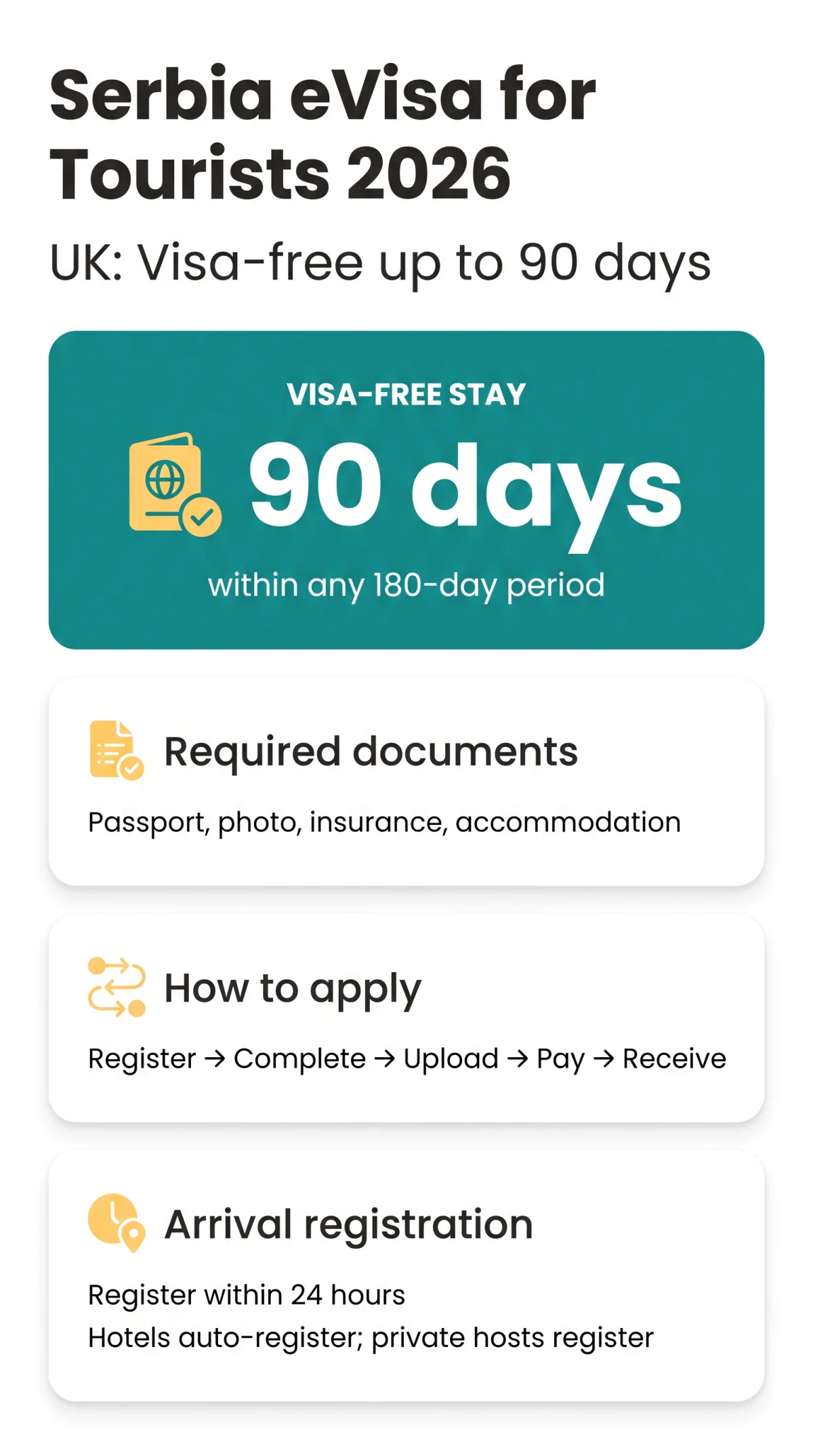
UK passport holders do not need a Serbia eVisa for tourists; they enter visa-free for up to 90 days within any 180-day period. Non-exempt nationals must apply online at evisa.welcometoserbia.gov.rs, submitting a valid passport, digital photograph, travel medical insurance, proof of accommodation, and evidence of financial means. The Serbia eVisa for tourists covers short-stay Visa C (up to 90 days) and long-stay Visa D purposes, using an electronic seal of the Ministry and QR codes for validation under ICAO Machine Readable Travel Documents standards.
Last reviewed: 15 September 2026 | Sources: mfa.gov.rs, welcometoserbia.gov.rs
Do UK Citizens Need a Serbia eVisa for Tourists in 2026?
UK passport holders of all nationality classes enter Serbia visa-free for up to 90 days in any 180-day period. Non-exempt nationals must instead obtain the Serbia eVisa for tourists through the Digital Travel Authorization system, launched on 23 April 2025 pursuant to the Serbian Law on Foreigners (“Official Gazette of RS” no. 24/18, 31/19 and 62/23).
Holders of a valid US multiple-entry visa or a Schengen Area residence permit may also enter visa-free under the substitute visa policy, based on the MFA decision adopted on 30 October 2014. A Biometric Residence Permit (BRP) alone does not grant visa-free entry; passport nationality determines the exemption. Travellers should verify their eligibility on the Ministry of Foreign Affairs portal before planning their trip. The Serbia eVisa for tourists remains the mandatory pathway for nationals outside the visa exemption list.
Required Documents for the Serbia eVisa Application
The Serbia eVisa for tourists requires applicants to submit a valid passport, a digital photograph, travel medical insurance, and proof of accommodation before travel. Evidence of financial means and intent to return must also be uploaded through the online portal at evisa.welcometoserbia.gov.rs.
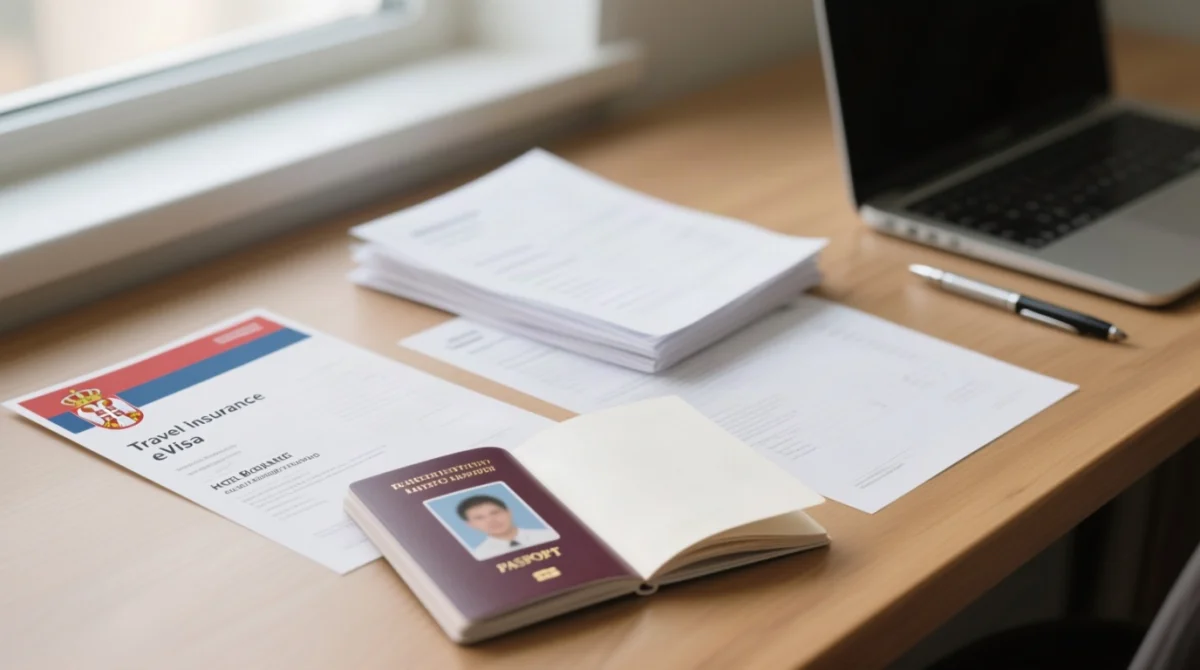
- Valid passport – valid for at least 90 days beyond the intended date of departure from Serbia, issued within the previous 10 years, with at least two consecutive blank pages.
- Digital passport-style photograph – biometric specifications, accepted formats JPEG or PNG, face-centred with a white or light background.
- Travel medical insurance – mandatory; must cover medical emergencies, hospitalisation, and repatriation.
- Proof of accommodation – hotel booking confirmation, rental contract, or itinerary from a travel agency.
- Proof of financial means – bank statements from the last 3 to 6 months demonstrating sufficient funds for the intended stay.
- Proof of intent to return – certificate of employment or education, or certificate of civil, family, or social status.
Applicants should verify all document specifications on the welcometoserbia.gov.rs portal before submission, as diplomatic-consular missions may request additional documentation during processing.
How to Apply for a Serbia eVisa from the UK
The Serbia eVisa for tourists is obtained entirely online through the Serbian eServices portal – no embassy visit is required.
Register
Register on the eIdentification Portal at eid.gov.rs, then log in to evisa.welcometoserbia.gov.rs using your eID credentials.
Complete
Complete the visa application form online with your personal and travel details.
Upload
Upload supporting documents: passport scan, digital photograph, and proof of accommodation.
Pay
Pay the consular fee – payment is what formally triggers submission of the application.
Receive
Receive the Digital Travel Authorisation via email once approved.
Apply 1-2 months before travel; no statutory timeframe exists. Diplomatic-consular missions may request further documents during processing.
Tourist Visits, Transit and Arrival Registration
Foreign visitors must complete registration upon arrival within 24 hours. Hotels register guests automatically, but private hosts – including Airbnb owners and family members being visited – must register the traveller at the nearest police station (MUP office). Failure to comply carries penalties under the Law on Foreigners (“Official Gazette of RS” no. 24/18, 31/19 and 62/23).
For transit, the Serbia eVisa for tourists does not apply to UK or EU passport holders, who transit visa-free under the standard 90 days within any 180-day period rule. Non-exempt nationalities may need Visa C for general transit or Visa A for airside transit at Belgrade Nikola Tesla Airport. Overland transit by personal vehicle requires a valid driver’s licence, vehicle insurance, and onward travel documentation proving the destination country entry right. The Serbia eVisa for tourists covers both leisure stays and border-to-border transit for non-exempt nationals.
Further details on visa exemption criteria and substitute visa rules are available on the Ministry of Foreign Affairs portal.
Family Visits and Medical Tourism Requirements
Family visits and medical travel require specific supporting documents beyond the standard Serbia eVisa for tourists application package.
For family or private visits, applicants must submit an invitation letter verified by a competent document verification authority. The Serbian host must include their first and last name, date of birth, citizenship, phone number, residential address, and reason to invite, alongside the applicant’s full name, date of birth, citizenship, and travel document details. By signing this letter, the inviter accepts liability for all costs related to the guest’s stay, forced eviction from Serbia, and possible placement in a shelter for foreigners.
Medical tourism via the Serbia eVisa for tourists requires a clinic admission letter from a registered Serbian healthcare facility, a doctor’s referral from the home country, and proof of treatment prepayment or financial guarantee. Travel medical insurance must cover complications and follow-up care. Short treatments fall under Visa C (up to 90 days), while extended care requires Visa D (exceeding 90 days). Applicants can verify facility registration through the Serbian Ministry of Health, and should consult evisa.welcometoserbia.gov.rs for the current application portal.
Student Exchanges and Minors Travelling to Serbia
Student exchange applicants need Visa D supported by university acceptance, while minors travelling alone or with one parent require a notarised parental consent letter.
For exchanges over 90 days within any 180-day period, Visa D requires a letter of acceptance from a Serbian university, proof of a bilateral exchange agreement between institutions, and evidence of financial support or scholarship. Health insurance and proof of accommodation complete the document package. Short-term academic visits or conferences under 90 days fall under Visa C through the standard Serbia eVisa for tourists framework.
For minors, the Serbia eVisa for tourists process requires a notarised parental consent letter in English or Serbian when a child travels alone or with only one parent. The letter must include the parent’s full name, the child’s details, travel dates, and the accompanying adult’s information. Where the parent and child have different surnames, a birth certificate must be carried as proof of relationship. Divorced or separated parents must provide a court custody order or written consent from both parties. Unaccompanied minors face additional inviter liability documentation, consistent with the Law on Foreigners (“Official Gazette of RS” no. 24/18, 31/19 and 62/23).
Serbia eVisa Fees, Processing Time and Technical Tips
The Serbia eVisa for tourists requires applicants to pay the consular fee online at evisa.welcometoserbia.gov.rs upon submission, as the application is formally recorded only after payment is completed. Verify the current fee on the portal; exact amount is not published in available sources. Accepted payment methods likely include international debit and credit cards such as Visa, Mastercard, and Maestro, though applicants should confirm available options directly on the portal.
Apply 1-2 months before travel to allow sufficient time for document verification. Diplomatic-consular missions retain the right to request additional documentation during processing.
For the online submission, the eVisa portal accepts files in PDF, JPEG, and PNG formats. The digital passport-style photograph must meet biometric specifications – face-centred with a white or light background – to avoid common upload errors. Applicants should also check browser compatibility before starting, as unsupported browsers may cause file-size or format rejections during the upload stage.
Frequently Asked Questions about Serbia eVisa for Tourists
Do UK citizens need an eVisa to visit Serbia in 2026?
No. UK citizens enter Serbia visa-free for up to 90 days within any 180-day period. A Serbia eVisa for tourists is not required for British passport holders.
How much does the Serbia eVisa cost?
The fee is payable in EUR online at evisa.welcometoserbia.gov.rs. The exact amount should be verified on the portal as it may change. UK tourists do not pay because they are visa-exempt.
What documents do I need for a Serbia tourist eVisa?
You need a passport valid 90+ days beyond departure, a digital photo, proof of accommodation, return travel, travel medical insurance, proof of financial means, and fee payment proof.
How long does the Serbia eVisa take to process?
No statutory timeframe is published. It is recommended to apply 1 to 2 months before your intended travel date to ensure sufficient processing time.
Can I use a BRP to enter Serbia visa-free?
No. A Biometric Residence Permit does not determine visa exemption. Your passport nationality determines your eligibility for visa-free entry to Serbia.
What is the substitute visa rule for Serbia?
Holders of a valid US multiple-entry visa or Schengen Area residence permit may enter Serbia visa-free for up to 90 days within 180 days, per the 2014 MFA decision.
Do minors need parental consent to enter Serbia?
Yes. A notarised parental consent letter in English or Serbian is required for minors travelling alone or with one parent. Proof of relationship may also be requested.
Do I need to register after arriving in Serbia?
Yes, within 24 hours. Hotels register guests automatically, but if staying in private accommodation, your host must register you at the nearest police station.