
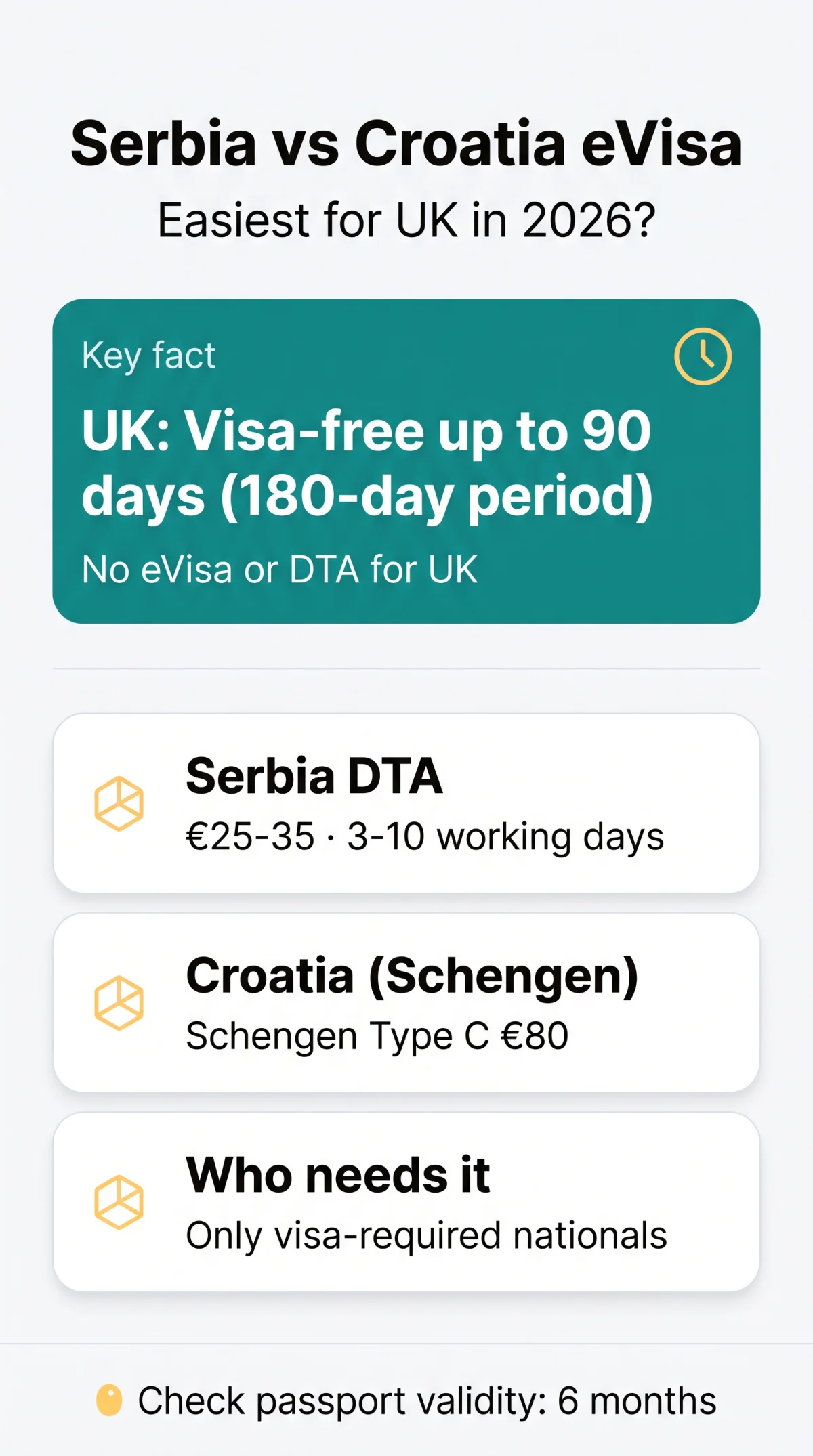
Last updated: September 2026. UK citizens do not need a Serbia eVisa or Croatia eVisa to visit either country in 2026. Both Serbia and Croatia allow visa-free entry for UK passport holders for up to 90 days within any 180-day period. Serbia’s Digital Travel Authorization (DTA), operational since 23 April 2025, is required only for nationals who would otherwise need a visa.
Croatia has no standalone eVisa – it joined Schengen on 1 January 2023 and issues Schengen Type C visas (EUR 80) via VFS Global. Serbia’s DTA costs €25-35 and processes in 3-10 working days. Neither applies to UK passport holders.
Do UK Citizens Need an eVisa for Serbia or Croatia in 2026?
UK passport holders enter both Serbia and Croatia visa-free for up to 90 days within any 180-day period, with no eVisa or DTA required.
Serbia has granted UK nationals unilateral visa-free entry since May 2003, according to the Serbian Ministry of Foreign Affairs (mfa.gov.rs). A UK visa itself does not grant entry to Serbia; it is UK nationality that qualifies the traveller for the exemption.
Croatia applies the standard Schengen 90/180-day rolling window following its full Schengen membership on 1 January 2023. Time spent in Croatia counts toward the aggregate Schengen allowance across all member states.
Serbia’s DTA (launched 23 April 2025) is only for visa-required nationals. UK passport holders are visa-exempt, so neither system applies. Since UK citizens are visa-exempt for both countries (Serbia since May 2003, Croatia under Schengen from Jan 2023), the DTA and Croatian Schengen visa are essential only for visa-required nationals who must use Serbia’s DTA (€25-35, 3-10 days) or Croatia’s Schengen visa (€80, VFS Global biometric centres).
Serbia eVisa vs Croatia eVisa – Head-to-Head Comparison
Serbia’s Digital Travel Authorization (DTA) processes 100% online at evisa.welcometoserbia.gov.rs, costing approximately €25-35 with a 3-10 working-day turnaround. Croatia has no standalone eVisa; it joined the Schengen Area on 1 January 2023 and issues standard Schengen Type C visas through VFS Global biometric centres at €80 for adults (€40 for children aged 6-12). Serbia’s DTA is not a Schengen visa and grants no access to Croatia or other Schengen states.
Serbia’s DTA is secured by an electronic seal from the Ministry of Foreign Affairs, dual QR verification codes, and complies with ICAO Machine Readable Travel Documents (MRTD) standards.
| Attribute | Serbia DTA | Croatia Schengen Visa |
|---|---|---|
| Form | Fully electronic | Schengen Type C sticker |
| Channel | 100% online | VFS Global centres + consular offices |
| Cost | ~€25-35 | €80 adult / €40 children 6-12 |
| Processing | 3-10 working days | Standard Schengen timeframe |
| Territorial scope | Serbia only | 27 Schengen states |
Full Comparison Table – Serbia vs All 7 Neighbouring Countries
Only Serbia and Albania have online eVisa/DTA portals. Croatia and Romania use Schengen; Montenegro, Bosnia, and North Macedonia are visa-free for UK citizens. Serbia’s DTA is the only fully digital system compliant with ICAO MRTD.
| Country | eVisa/DTA Available | Application Method | Fee | Processing Time | Max Stay (UK nationals) | Entry Type | Serbia Advantage |
|---|---|---|---|---|---|---|---|
| Serbia | Yes (DTA) | Online | ~€25-35 | 3-10 working days | 90/180 days | Electronic | Only Balkan DTA with ICAO MRTD compliance & dual QR verification |
| Croatia | No (Schengen) | VFS Global / consular | €80 (adult) | Standard Schengen | 90/180 days | Sticker | Serbia DTA costs less and skips in-person biometric appointment |
| Montenegro | No | N/A (visa-free) | N/A | N/A | 90 days | Visa-free | Serbia offers a digital option for non-exempt nationalities |
| Albania | Yes (eVisa portal) | Online | ~€40 | Varies | 90 days | Electronic | Serbia DTA is cheaper and ICAO-compliant; Albania lacks QR verification |
| Bosnia & Herzegovina | No | N/A (visa-free) | N/A | N/A | 90 days | Visa-free | Serbia provides digital authorisation for visa-required nationals |
| North Macedonia | No | N/A (visa-free) | N/A | N/A | 90 days | Visa-free | Serbia DTA fills the gap for non-exempt travellers |
| Romania | No (Schengen) | N/A (visa-free for UK) | N/A | N/A | 90/180 days | Visa-free | Serbia’s DTA remains the only standalone Balkan digital portal |
How to Apply for Serbia’s Digital Travel Authorization – Step by Step
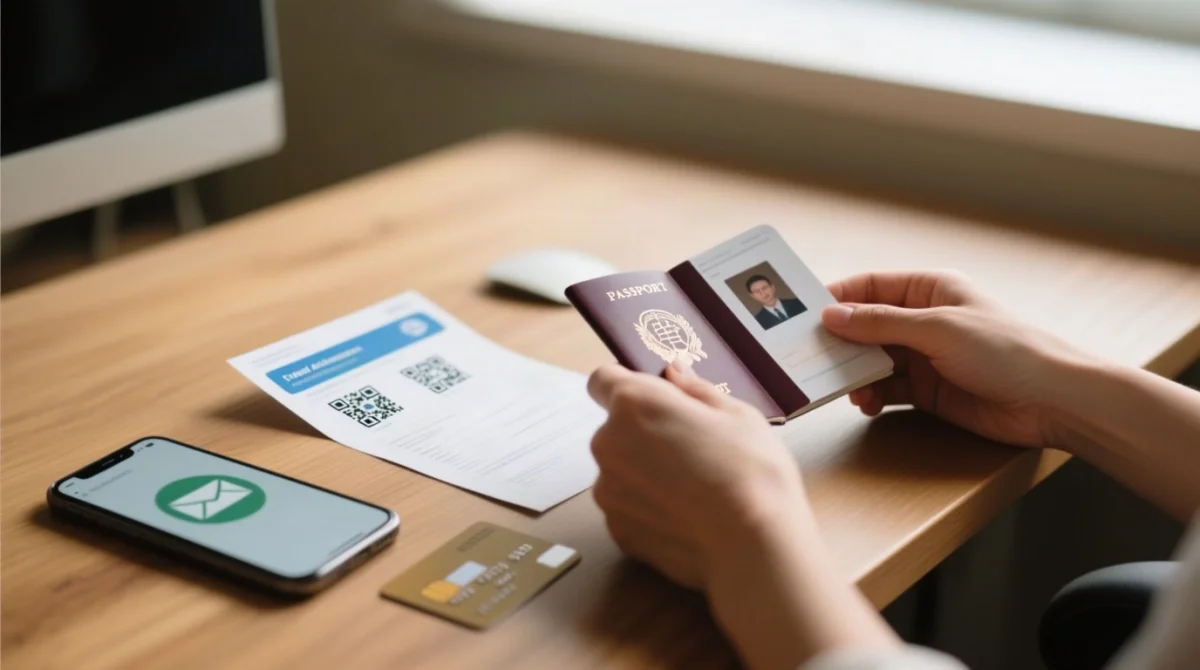
Apply at evisa.welcometoserbia.gov.rs: register, fill form, upload documents (PDF/JPG), pay online (~€25-35), receive decision in 3-10 working days.
Register via the Electronic Identification Portal
Create your account at eid.gov.rs.
Complete the application form in English
Fill in all required fields of the electronic form.
Upload documents
Submit passport scan (PDF/JPG), photograph, and itinerary.
Pay online
Approximately €25-35 by debit or credit card in EUR or RSD.
Receive the decision by email
Decision arrives within 3-10 business days.
Each approved Serbia DTA carries an electronic seal from the Ministry of Foreign Affairs and dual QR codes for border verification. If a DTA cannot be issued, a traditional visa sticker is provided at a consulate abroad. Ensure passport validity is at least 6 months, document scans are clear, and payment card authorisation is successful to avoid the most frequent DTA rejections.
Neighbouring Countries and Multi-Country Balkan Trip Planning
A UK passport holder can travel London → Belgrade → Podgorica → Sarajevo → Dubrovnik → Bucharest with no visas, but the Bosnia-Croatia border is an external Schengen frontier requiring passport control.
Montenegro, Albania, Bosnia & North Macedonia
- Montenegro – no eVisa portal; UK nationals enter visa-free for 90 days.
- Albania – the only other Balkan country with an online eVisa system (operational since ~2021, fee ~€40); UK citizens still enter visa-free.
- Bosnia & Herzegovina – no eVisa; UK nationals stay visa-free 90 days. Serbia and Bosnia have never required visas for each other’s citizens, and ID-card travel is accepted.
- North Macedonia – no eVisa; UK nationals stay visa-free 90 days.
Romania and the Schengen Border
- Romania is a full Schengen member (air/sea borders from March 2024); UK nationals enter visa-free for 90 days within any 180-day period.
- Crossing from Bosnia into Croatia means hitting an external Schengen frontier – passport control applies.
- EU’s Entry/Exit System (EES) digitally tracks third-country nationals across Schengen; check your allowance at travel-europe.europa.eu/ees/check-how-long-you-can-stay.
Special Cases – Kosovo Passports, UK BRP Holders and ID Card Travel
Kosovo passports are not accepted for entry into Serbia; Kosovar citizens must use an ID card only. UK Biometric Residence Permit (BRP) holders who are not UK nationals need either a Serbia Digital Travel Authorization (DTA) or a Schengen visa for Croatia, depending on their nationality – the BRP alone does not grant visa-free entry to either country. UK nationals themselves remain visa-free for both Serbia and Croatia regardless of BRP status.
Serbia accepts ID cards from EU member states, Albania, Bosnia and Herzegovina, Montenegro, North Macedonia, Iceland, Liechtenstein, Norway, and Switzerland. Dual passport travel to Serbia is permitted: travellers may present an expired passport containing a valid visa alongside a valid passport without a visa. Holders of a valid US multiple-entry visa or US residence permit may enter Serbia visa-free for 90 days within any 180-day period, provided the US visa or permit remains valid for the entire length of stay.
FAQ: Serbia eVisa vs Croatia eVisa for UK Travellers (2026)
Do UK citizens need a visa or eVisa to visit Serbia in 2026?
No. UK passport holders have been visa-exempt for Serbia since May 2003 (90 days within any 180-day period). Serbia’s DTA (launched 23 April 2025) applies solely to nationals who would otherwise need a visa.
Do UK citizens need a visa or eVisa to visit Croatia in 2026?
No. Croatia is a full Schengen Area member since 1 January 2023. UK nationals enter visa-free for up to 90 days within any 180-day period. Visa-required nationals must apply for a Schengen Type C visa via VFS Global.
What is Serbia’s Digital Travel Authorization (DTA) and who is it for?
The DTA is Serbia’s fully electronic travel authorisation (operational since 23 April 2025 at evisa.welcometoserbia.gov.rs), compliant with ICAO MRTD standards and secured by dual QR codes. It is required only for nationals of visa-required countries.
How long does it take to process a Serbia DTA application?
The standard processing time is 3 to 10 working days, with status notifications sent by email. If a DTA cannot be issued, a traditional visa sticker at a Serbian consulate abroad serves as the fallback.
How much does the Serbia DTA cost?
The DTA fee is approximately €25 to 35, payable online by debit or credit card in EUR or RSD. Confirm the current fee on the DTA portal before submitting an application.
Can I use Serbia’s DTA to enter Croatia or other Schengen countries?
No. Serbia is not part of the Schengen Area. The DTA authorises entry to Serbia only. Croatia applies the Schengen acquis; a Schengen short-stay visa (Type C, €80 for adults) is required for visa-required nationals.
Is Serbia visa a Schengen visa?
No. Serbia is not a member of the Schengen Area. The DTA is a national digital authorisation issued solely by the Republic of Serbia and does not grant access to Croatia, Romania, or any other Schengen state.
Is Serbia visa free for UK BRP holders?
UK nationals enter Serbia visa-free. Non-UK BRP holders are assessed by their nationality. If their nationality appears on Serbia’s visa-required list, they must apply for a DTA or a traditional visa sticker.
Can I enter Croatia with the UK BRP?
UK nationals enter Croatia visa-free under Schengen rules. Non-UK BRP holders are assessed by nationality. If a Schengen visa is required, they must apply for a Type C short-stay visa (€80) through VFS Global or a Croatian diplomatic mission (Trg N.Š. Zrinskog 7-8, 10000 Zagreb, +385 (0)1 4569 964).
Which Balkan country is easiest for UK citizens to visit visa-free?
All seven neighbouring countries allow UK passport holders visa-free entry for up to 90 days: Serbia, Croatia, Montenegro, Albania, Bosnia and Herzegovina, North Macedonia, and Romania. No eVisa or DTA is needed.
Can I travel through multiple Balkan countries on a single Serbia DTA?
No. The Serbia DTA authorises entry to Serbia only. For visa-required nationals, each neighbouring country applies its own rules: Croatia and Romania use Schengen visas; Montenegro, Bosnia and Herzegovina, North Macedonia, and Albania have separate procedures.
What documents do I need for the Serbia DTA application?
The DTA application at evisa.welcometoserbia.gov.rs requires registration, a completed electronic form, document upload (PDF/JPG), and online payment. A valid passport is the core requirement. Status updates are emailed.