
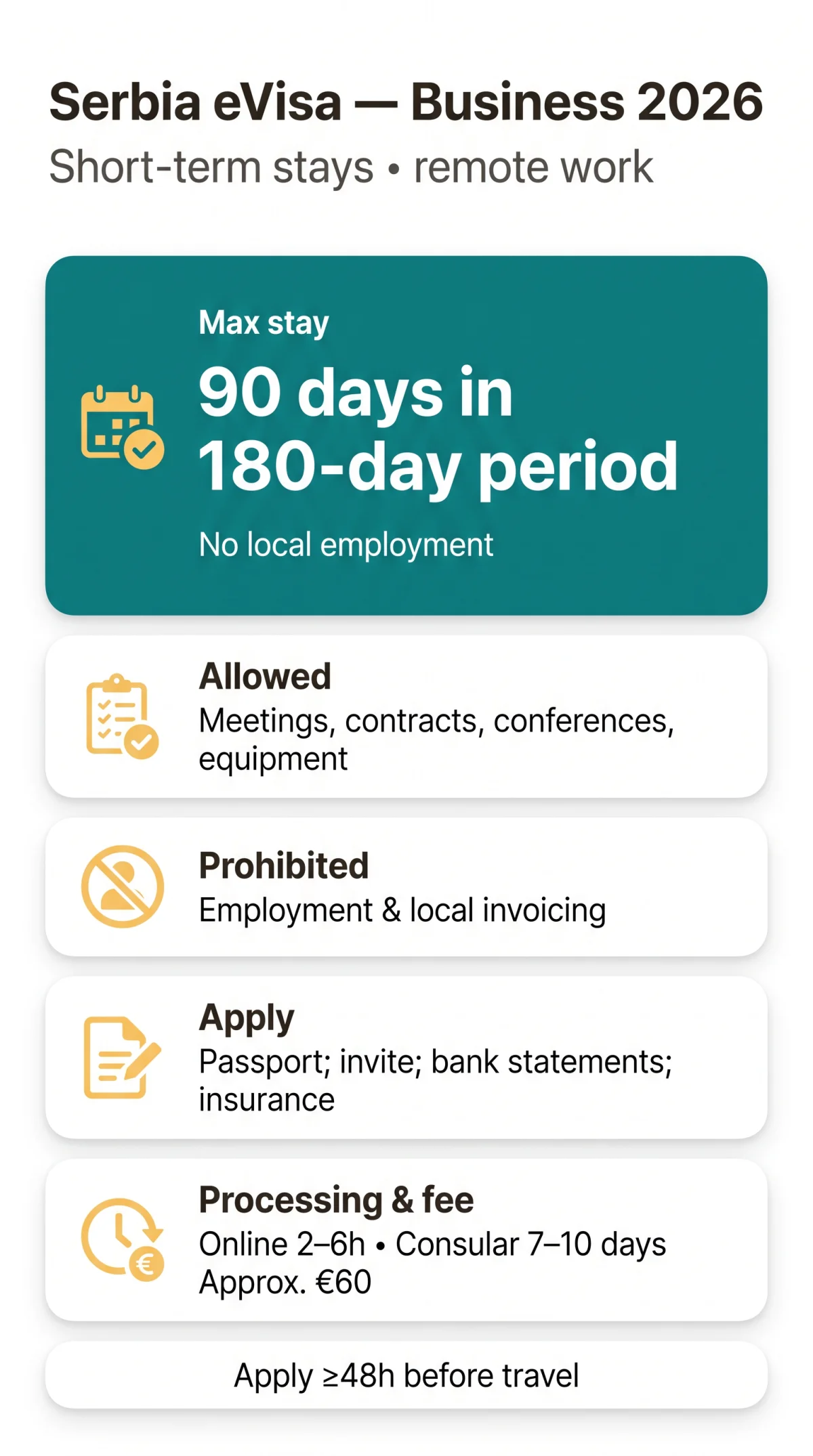
The Serbia eVisa for business owners permits short-term activities such as business meetings, deal-signing, conferences, and investment negotiations. Remote work for foreign clients is a legal grey zone. Serbia has no dedicated digital nomad visa in 2026; UK citizens can enter visa-free for up to 90 days.
For entrepreneurs planning a trip, understanding the boundaries of permitted work is critical. The short-term C visa does not authorise local employment. Business owners must rely on specific pathways for longer stays, such as a D visa or a single permit. Pursuant to Article 3, Paragraph 1, Point 13c) of the Law on Foreigners (Official Gazette of RS no. 24/18, 31/19 and 62/23), the Welcome to Serbia portal serves as the primary application platform.
What Is the Serbia eVisa for Business Owners in 2026?
The Serbia eVisa for business owners is an electronic Digital Travel Authorization (DTA) launched on 23 April 2025 via the welcometoserbia.gov.rs portal, providing approval for entry, stay, or transit before arriving in Serbia. The DTA is issued in electronic form, featuring an electronic seal of the Ministry and a 2D QR barcode that border authorities scan to verify validity. If DTA conditions are not met, a traditional sticker visa affixed to the passport serves as fallback.
The Serbia eVisa for business owners operates within the short-term C visa framework. For longer business stays, a D visa is required. UK passport holders enjoy visa-free entry for business purposes but may use the DTA for specific business categories. Eligible passports must be valid at least 90 days after departure, issued within the previous 10 years, and contain at least two consecutive blank pages.
What Work Activities Are Actually Permitted on a Serbia eVisa?
The Serbia eVisa for business owners permits meetings, deal-signing, conferences, and equipment installation, but prohibits paid employment for Serbian entities. A specific work permit exemption allows business activities preparing a foreign employer to establish presence in Serbia for up to 90 days within a 180-day period counted from the date of first entry. Intra-company transferees performing installation or technical cooperation tasks fall within this exemption.
| Scenario | Allowed? | Legal Basis |
|---|---|---|
| Attending business meetings and negotiations | ✅ Permitted | C visa business purposes |
| Signing distribution contracts | ✅ Permitted | C visa business purposes |
| Attending trade fairs and exhibitions | ✅ Permitted | C visa business purposes |
| Equipment/production plant installation | ✅ Permitted | Business cooperation; work permit exemption |
| Intra-company transfer for technical tasks | ✅ Permitted | Work permit exemption (up to 90 days) |
| Board meetings and shareholder votes | ✅ Permitted | C visa business purposes |
| Seeking investments and due diligence | ✅ Permitted | C visa business purposes |
| Remote work for foreign (non-Serbian) clients | 🟡 Grey Zone | Not explicitly prohibited nor authorised |
| Invoicing Serbian customers for services | ❌ Prohibited | Requires single permit or residence permit |
| Paid employment for a Serbian entity | ❌ Prohibited | Requires Visa D or single permit |
| Self-employment without a permit | ❌ Prohibited | Requires temporary residence permit |
| Performing services for Serbian businesses | ❌ Prohibited | Requires work authorisation |
The Serbia eVisa for business owners explicitly restricts local employment to protect the Serbian labour market. Any activity exceeding the visa’s stated scope may result in penalties or future entry bans.
Remote Work & Digital Nomad Stays: Your Real Options in 2026
Serbia has no dedicated digital nomad visa in 2026. The Serbia eVisa for business owners allows remote work for foreign clients during a visa-free 90-day stay, though this sits in a legal grey zone under the Law on Foreigners. For longer stays, UK entrepreneurs must transition to a residence-based pathway: a self-employment residence permit or company registration (d.o.o.) with a single permit (integrated temporary residence and work permit valid up to 36 months).
| Pathway | Duration | Requirements | Best For |
|---|---|---|---|
| Visa-free stay + remote work | Up to 90 days in 180 days | UK passport valid 90 days beyond departure | Short visits, laptop work for non-Serbian clients |
| Self-employment residence permit | Visa D up to 180 days; single permit up to 36 months | Visa D or single permit; labour market test if employed | Sole traders, freelancers relocating long-term |
| Company registration (d.o.o.) + single permit | Single permit up to 36 months | Business Registers Agency registration; single permit application | Founders establishing a Serbian entity |
Employment-based single permits require the employer to first complete a labour market test procedure. A Visa D based on employment is limited to 180 days before the single permit application becomes mandatory. The Serbia eVisa for business owners does not authorise local employment or self-employment on Serbian soil.
Investment Visits: What You Can Do and What Capital Is Required
The Serbia eVisa for business owners permits property viewings, investment negotiations, and due diligence meetings. Serbia has no formal investment visa scheme or published minimum capital threshold for temporary residency without full company formation. Permitted short-term investment activities include:
- Property viewings and real-estate inspections
- Investment negotiations with Serbian partners or sellers
- Due diligence meetings with legal, accounting, or advisory firms
- Attending investor briefings and trade fairs
- Scouting locations for potential business operations
For UK entrepreneurs seeking longer-term residency through investment, the eVisa alone is insufficient. Establishing a company (d.o.o.) or entrepreneurial store requires either a Visa D (maximum 180 days for employment-based stays) or a single permit (valid up to 36 months). Serbia does not offer a residency-by-investment programme with a set minimum capital amount; real-estate purchase may serve as a residency pathway but is not a distinct visa category. Further details on company registration are available via the Welcome to Serbia portal, which directs applicants to the Business Registers Agency as the competent registration authority.
How to Apply for the Serbia eVisa: Documents, Process & Fees
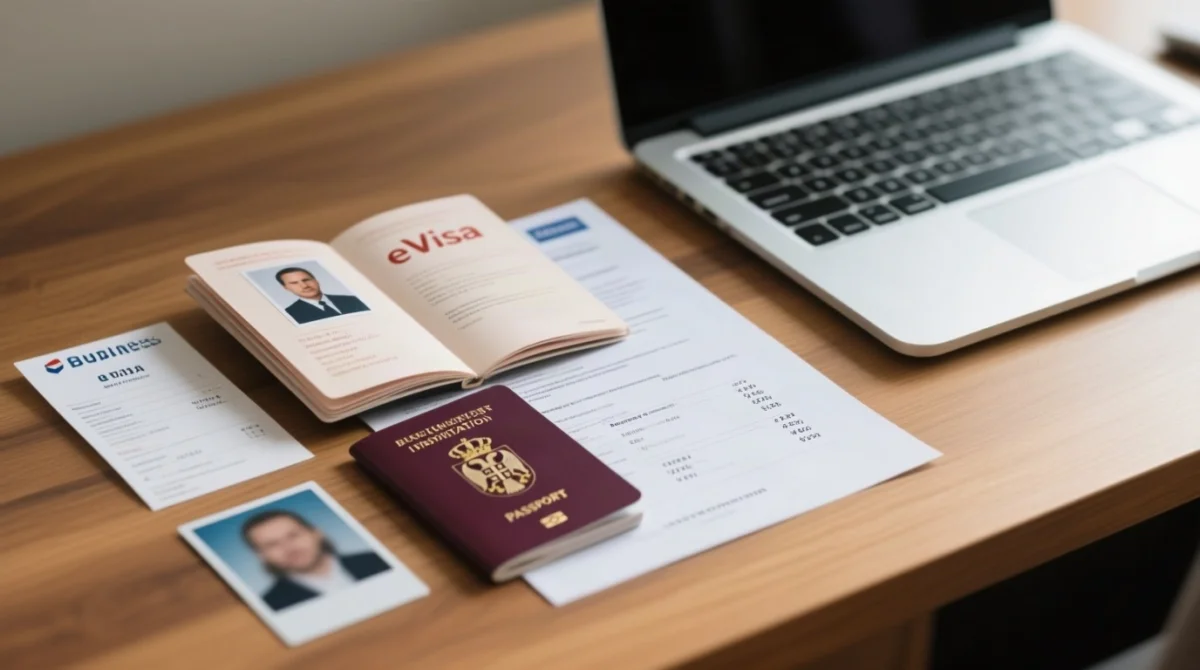
The Serbia eVisa for business owners requires a passport scan, business invitation letter, proof of financial means, and travel insurance, submitted through the government’s Digital Travel Authorization platform.
Register on eid.gov.rs
Create an Electronic Identification account before accessing the application portal.
Complete the online application on welcometoserbia.gov.rs
The DTA system has been operational since 23 April 2025.
Upload required documents:
Passport bio-data page scan, invitation letter from a Serbian legal entity (including inviter’s TIN, registration number, and cost-liability statement), bank statements from the last 3 months, travel medical insurance, applicant’s photo, and proof of visa fee payment.
Pay the visa fee
The application is submitted to the competent authority upon payment. The approximate C visa fee is ~€60 (external source, July 2026); check the Serbian Official Gazette or welcometoserbia.gov.rs for the current schedule.
Receive the electronic DTA
As of September 2026, online processing typically takes 2 to 6 hours. Consular processing takes 7 to 10 business days. Apply at least 48 hours before departure.
If DTA conditions are not met, the system falls back to a sticker visa affixed to the travel document. The Serbia eVisa for business owners does not guarantee approval; consular missions reserve the right to request additional documentation during processing.
Stay Duration, Extensions & Tax Implications
The Serbia eVisa for business owners allows a maximum stay of up to 90 days within any 180-day period. Extensions of up to 30 additional days are possible but require a valid reason (ongoing negotiations, medical emergencies) and are not guaranteed; applicants must visit a local police station and pay a small administrative fee.
For longer engagement, a visa D based on employment permits stays of up to 180 days, after which a single temporary residence and work permit (valid up to 36 months) becomes necessary. The employer must initiate a labour market test before the single permit application can proceed.
| Activity | Tax Residency Trigger? | Permanent Establishment Risk? | UK DTA Applies? |
|---|---|---|---|
| Passive investment visit (property viewing) | No | No | Yes |
| Active contract negotiation | No (under 90 days) | Possible if signing binding contracts | Yes |
| Company establishment (d.o.o.) | Yes, if registered | Yes, once operational | Yes |
| Remote work for foreign clients | No (under 90 days) | No | Yes |
A 30 to 90 day business stay generally does not trigger Serbian personal income tax; however, signing contracts or opening a branch may create a permanent establishment risk. The Serbia-UK double taxation agreement applies. The Serbia eVisa for business owners does not cover tax advisory; consult a Serbian tax advisor for activity-specific guidance.
UK-Specific Entry Requirements & Travel Advice
UK passport holders enter Serbia visa-free for up to 90 days for business purposes. The Serbia eVisa for business owners may still be used for specific business categories requiring formal DTA approval. Passport requirements: valid at least 90 days after departure, issued within the previous 10 years, and containing at least two consecutive blank pages.
- BRP holders: Non-UK nationals with a UK BRP do NOT automatically get visa-free entry. Eligibility depends on passport nationality, not UK residency status. Check the MFA visa-free country list.
- Cash declaration: Amounts of €10,000 or above must be declared to Serbian Customs Administration upon entry.
- Registration upon arrival: The person being visited must report the foreigner’s accommodation within 24 hours to the competent authority.
- Travel medical insurance: Mandatory for all visitors.
The Serbia eVisa for business owners remains available to UK applicants who prefer formal electronic authorisation alongside their visa-free entry.
FAQ
Can I work remotely on a Serbia eVisa for business owners?
Yes, for foreign clients. It is a legal grey zone and not explicitly prohibited if you are not employed by a Serbian entity. For long-term remote work, consider a self-employment permit or company registration.
Is Serbia visa-free for UK BRP holders?
No. UK passport holders are visa-free, but non-UK nationals with a UK BRP do NOT automatically get visa-free entry. It depends on your passport nationality, not UK residency status.
How much bank balance is required for a Serbia visa?
There is no fixed statutory amount. A recommended minimum is approximately €50 per day of stay (e.g., €1,500 for a 30-day trip). Proof of sufficient funds via bank statements is required.
Can I extend my Serbia eVisa for business purposes?
Yes, up to 30 additional days. This requires a valid reason (like ongoing negotiations) and is not guaranteed. You must visit a local police station and pay a small administrative fee.
Do I need a separate visa for investment visits to Serbia?
No. Property viewings, investment negotiations, and due diligence meetings are permitted on the standard C visa or eVisa. For long-term investment, you need a D visa or single permit.
What is the Serbia eVisa fee for business owners in 2026?
The approximate C visa fee is ~€60. Online DTA processing fees may differ. Always check the Official Gazette or welcometoserbia.gov.rs for the current fee schedule.
Can I open a bank account in Serbia on a business eVisa?
Some banks allow non-residents on a C visa to open accounts. Requirements vary but typically include a passport, proof of address, and a Serbian tax identification number (TIN).
Is there a dedicated digital nomad visa for Serbia in 2026?
No. Alternatives include a visa-free 90-day stay with remote work for foreign clients, a self-employment residence permit, or company registration with a single permit.
How long does it take to get a Serbia eVisa for business owners?
As of September 2026, online DTA processing typically takes 2 to 6 hours. Consular processing takes 7 to 10 business days. Apply at least 48 hours before departure.
What documents do I need for the Serbia eVisa application?
You need a passport bio-data scan, a business invitation letter from a Serbian legal entity, bank statements, travel medical insurance, a business schedule, and proof of business registration.
This article is for informational purposes only and does not constitute legal or tax advice. Always consult a qualified Serbian immigration lawyer or the Welcome to Serbia portal before making travel or business decisions.
Published: 15 September 2026 | Last reviewed: 15 September 2026