
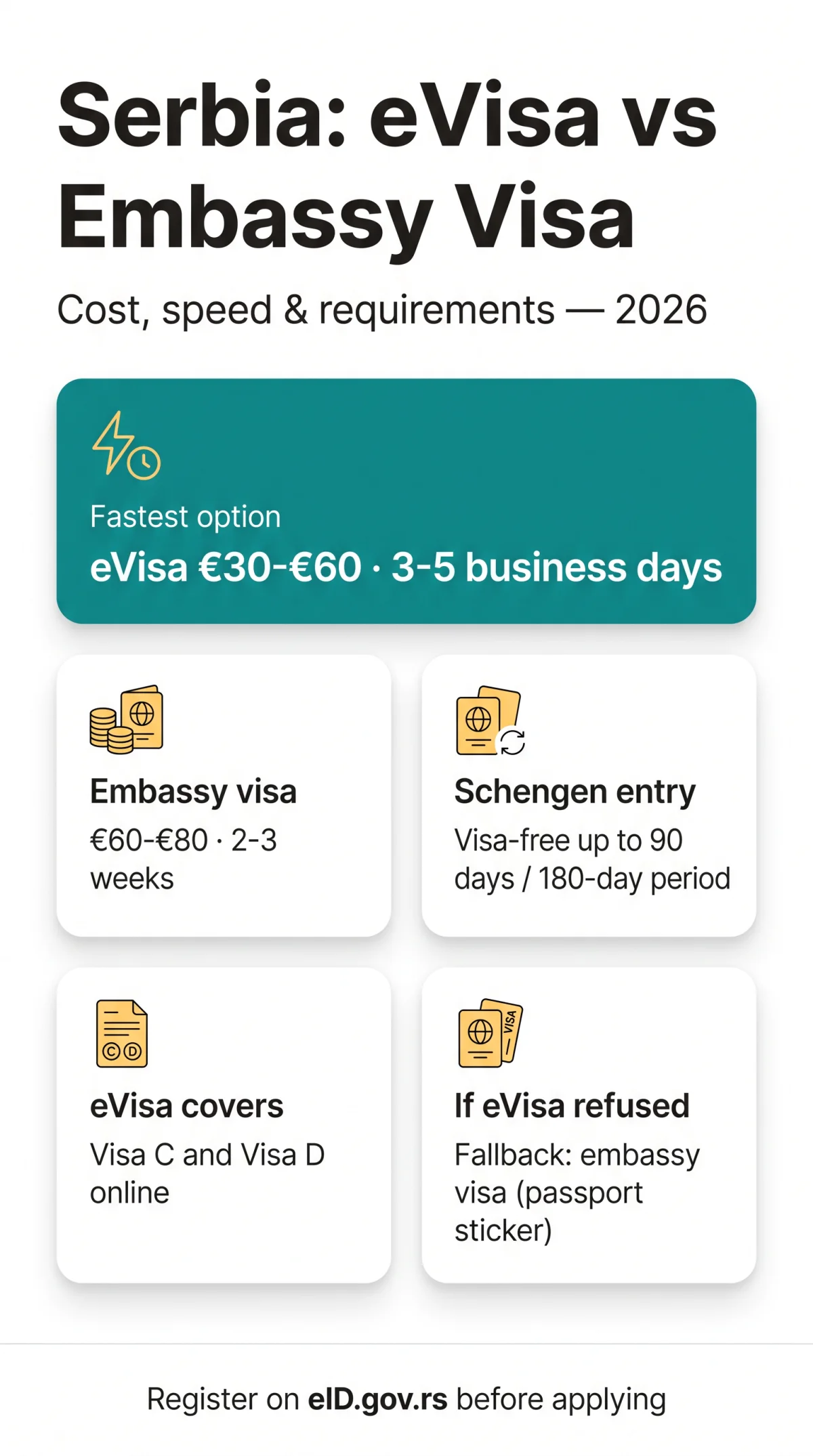
Serbia eVisa vs embassy visa: The eVisa (Digital Travel Authorization) costs €30-€60, processes in 3-5 business days, and requires only online documents. The Serbia embassy visa costs €60-€80, takes 2-3 weeks, and requires in-person biometrics. UK citizens may also enter visa-free with a valid Schengen visa or residence permit.
Introduction: Which Serbia Entry Option Is Right for You?
British travellers evaluating Serbia’s visa regime in 2026 choose between the Serbia eVisa, the Serbia embassy visa, Schengen-based entry, and the absence of visa-on-arrival.
February 2024
“Welcome to Serbia” portal operational
19 March 2025
Memorandum of Cooperation signed (MFA Marko Đurić & Office for IT and eGovernment Mihail Jovanović)
23 April 2025
Serbia eVisa (DTA) launched
The Portal for Foreigners has processed 43,961 single temporary residence and work permit applications to date. The Serbia embassy visa remains the traditional consular route. This content is independently produced; all links to government portals are provided for reference only.
Serbia eVisa vs Embassy Visa: Visa Types & Formats in 2026
Launched 23 April 2025, the Serbia eVisa is an ICAO-compliant electronic authorisation with a Ministry electronic seal and border QR code. The Serbia embassy visa remains a physical sticker affixed to the passport, issued as Visa C (short-stay, up to 90 days) or Visa D (long-stay, up to 180 days) through a consulate general abroad. The Serbia eVisa covers both Visa C and Visa D categories online. Serbia does not offer traditional visa-on-arrival; the DTA is a pre-travel digital authorisation, not a border-issued visa. The Serbia embassy visa is required when the DTA is refused. Holders of a valid Schengen Type C multi-entry visa or Schengen-zone residence permit may enter Serbia visa-free per the 2014 Decision.
| Entry Type | What It Is | Key Difference |
|---|---|---|
| eVisa (DTA) | Digital Travel Authorization obtained prior to travel via evisa.welcometoserbia.gov.rs; electronic format with QR code and MFA electronic seal | Online-only, no consulate visit; Visa C and Visa D both apply |
| Embassy Visa | Visa sticker affixed to passport; Visa C (short-stay) or Visa D (long-stay), single or multiple entry | Requires in-person submission at a Serbian consulate; biometric data collected |
| Visa-on-Arrival | Not offered by Serbia | DTA is pre-travel authorisation, not a border-issued visa |
| Schengen-Based Entry | Visa-free entry for holders of valid Schengen Type C multi-entry visa or Schengen-zone residence permit | Free, instant; up to 90 days within a 180-day period |
Who Needs a Serbian Visa? Eligibility & Visa-Free Exemptions
Under the Government Decision on Visa Free Entry adopted 30 October 2014, British passport holders enter Serbia visa-free for up to 90 days within a 180-day period. Valid Schengen Type C multi-entry visa or residence permit holders also qualify visa-free under the 90/180 rule. Whether you need a Serbia eVisa or Serbia embassy visa depends on nationality and passport type, not UK residency alone.
- UK passport holders: No visa required; stay up to 90 days within 180 days.
- Schengen visa/permit holders: Free entry; valid for the duration of the underlying Schengen document.
- UK BRP holders from visa-required countries: Eligibility depends on nationality and passport type. Travel documents issued under international conventions are excluded from visa-free entry.
- Visa-required nationals: Must apply for either the Serbia eVisa (DTA) online or a Serbia embassy visa at a consulate general abroad.
Full conditions are on the Serbian MFA Visa Requirements page.
How to Apply: eVisa vs Embassy Visa Step by Step
The Serbia eVisa is completed entirely online, while the Serbia embassy visa demands an in-person visit to a consulate general abroad.
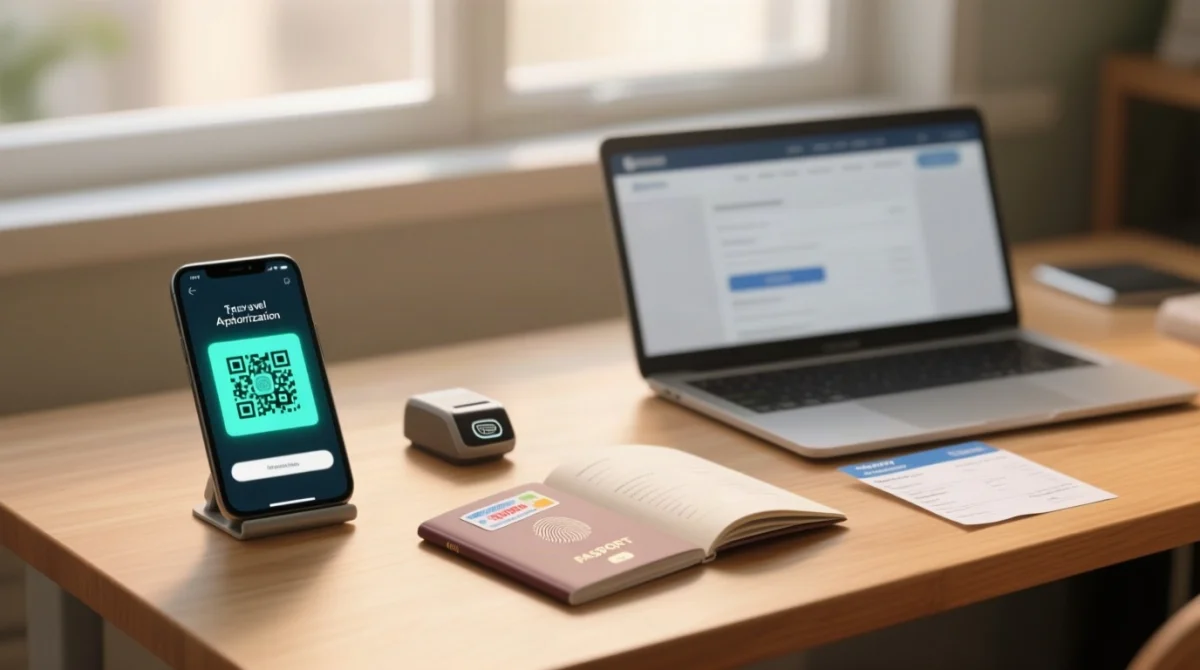
Serbia eVisa Application Steps
Register on eID.gov.rs
Required for all online applications.
Log in to welcometoserbia.gov.rs
Select Visa C (short-stay) or Visa D (long-stay).
Upload documents
Passport valid 6+ months, digital photo, travel insurance.
Pay the government fee
Fee of €30-€60 paid online.
Receive the DTA by email
Includes a border check QR code for validation at entry.
Serbia Embassy Visa Application Steps
- Book an in-person appointment at the nearest Serbian consulate in the UK.
- Submit your passport, physical photo, itinerary, proof of funds, and biometric data.
- Collect your passport with the visa sticker affixed after 2-3 weeks.
The Serbia eVisa eliminates consulate queues and biometric collection. The Serbia embassy visa remains necessary for long-stay or complex cases where the DTA is refused.
Cost & Processing Time: Speed and Budget Comparison
The Serbia eVisa costs €30-€60 and processes in 3-5 business days; the Serbia embassy visa costs €60-€80 and takes 2-3 weeks. The Serbia eVisa fee is paid online via welcometoserbia.gov.rs; the Serbia embassy visa fee is payable at the consulate. Schengen-based entry carries no cost and requires no processing. Serbia does not offer visa-on-arrival.
| Option | Fee (EUR) | Processing Time | Payment Method |
|---|---|---|---|
| Serbia eVisa (DTA) | €30-€60 | 3-5 business days | Online via portal |
| Serbia embassy visa | €60-€80 | 2-3 weeks | At consulate appointment |
| Schengen-based entry | Free | Instant (no processing) | N/A |
| Visa-on-arrival | N/A | N/A | Not offered by Serbia |
Required Documentation Checklist
The Serbia eVisa requires a passport valid 6+ months, a digital photo, and travel insurance uploaded online. The Serbia embassy visa adds in-person biometrics, proof of funds, and a physical photograph submitted at the consulate. Entry and stay regulations differ: the Serbia eVisa covers Visa C and D online, while the Serbia embassy visa separates these categories with distinct application forms.
| Document | Serbia eVisa | Serbia Embassy Visa |
|---|---|---|
| Passport (6+ months valid) | Yes (upload scan) | Yes (submit physical) |
| Photograph | Digital upload | Physical print |
| Travel insurance | Yes (upload) | Yes (submit copy) |
| Itinerary | Not typically required | Yes |
| Proof of funds | Not typically required | Yes |
| Biometric data | No | Yes (collected in person) |
Schengen-based entry requires only a valid Schengen Type C multi-entry visa or residence permit plus a passport at the border.
Serbia eVisa vs Embassy Visa: Full Comparison Table
The Serbia eVisa is the cheapest and fastest option at €30-€60 with 3-5 business day processing. The Serbia embassy visa provides a physical passport sticker for long-stay needs at €60-€80 over 2-3 weeks. The Serbia eVisa eliminates consulate visits; the Serbia embassy visa remains the fallback when digital authorisation is refused. Serbia does not offer visa-on-arrival; Schengen document holders enter free and instantly.
| Option | Cost (EUR) | Processing Time | Application Method | Key Documents | Stay Duration | Best For | Notes |
|---|---|---|---|---|---|---|---|
| eVisa (DTA) | €30-€60 | 3-5 business days | Online via welcometoserbia.gov.rs | Passport (6+ months valid), digital photo, travel insurance | Up to 90 days | Fast, budget-friendly short trips | Digital authorisation with QR code; no consulate visit |
| Embassy Visa | €60-€80 | 2-3 weeks | In-person at Serbian consulate | Passport, photo, itinerary, proof of funds, biometrics | Up to 90 days (C) or 180 days (D) | Long-stay, complex cases | Sticker affixed to passport; biometrics collected |
| Visa-on-Arrival | N/A | N/A | Not offered by Serbia | N/A | N/A | N/A | Use eVisa or embassy visa instead |
| Schengen-Based Entry | Free | Instant | At the border | Valid Schengen C visa or residence permit + passport | Up to 90 days / 180 | UK/EU residents with existing Schengen docs | Based on 2014 Government Decision |
Using a Schengen Visa or Residence Permit for Serbia
Holders of a valid Schengen Type C multi-entry visa or Schengen-zone residence permit enter Serbia visa-free for up to 90 days within a 180-day period, per the Government Decision adopted 30 October 2014. This applies to UK residents who already hold Schengen documents. The visa-free stay rule (90/180) is tied to the validity of the underlying Schengen document. Excluded are travel documents issued under international conventions. Unlike the Serbia eVisa or Serbia embassy visa, Schengen-based entry requires no application, no fee, and no processing. This pathway benefits travellers who would otherwise need a Serbia eVisa or Serbia embassy visa, saving both cost and time.
Practical Scenarios: eVisa Refusal, Fallback & Expo 2027
If a Serbia eVisa (DTA) is refused, the official fallback is a Serbia embassy visa: a sticker affixed to the travel document. Refusal grounds, per the MFA, include protection of security or interests of the Republic of Serbia and concerns related to irregular migration. The Serbia eVisa refusal triggers a mandatory switch to the Serbia embassy visa route at a consulate general abroad. Serbia also permits entry with two passports: an expired national passport containing a valid visa or residence permit, paired with a valid new passport. Looking ahead, Serbia plans electronic visas via the Portal for Foreigners for all Specialised Expo 2027 Belgrade participants, building on the DTA system launched 23 April 2025.
FAQ: Serbia eVisa vs Embassy Visa
What is the difference between Serbia eVisa and embassy visa?
The Serbia eVisa is an online application (3-5 days, €30-€60); the embassy visa requires in-person processing (2-3 weeks, €60-€80) and yields a passport sticker.
How much does a Serbia eVisa cost for UK citizens in 2026?
The government fee for a Serbia eVisa in 2026 is €30-€60, paid entirely online through the welcometoserbia.gov.rs portal.
Can I enter Serbia with a valid Schengen visa?
Yes. Holders of a valid Schengen Type C multi-entry visa or a Schengen-zone residence permit can enter Serbia visa-free for up to 90 days within a 180-day period, per the 2014 Decision.
Does Serbia offer visa-on-arrival for British passport holders?
No. Serbia does not offer traditional visa-on-arrival. The DTA is a pre-approved digital authorisation that must be obtained prior to entering Serbia, not a border-issued visa.
How long does it take to get a Serbia eVisa?
The typical processing time for a Serbia eVisa is 3-5 business days, provided all documentation is complete and there are no security concerns.
What documents do I need for a Serbia embassy visa?
For a Serbia embassy visa, you must submit a passport valid for at least six months, a completed application form, a physical photograph, an itinerary, proof of funds, and travel insurance. Biometric data is collected during your in-person appointment at the consulate.
Can I enter Serbia with two passports?
Yes. Serbia permits entry with two passports: an expired national passport containing a valid visa or residence permit, alongside a valid new national passport without a visa.
What happens if my Serbia eVisa is refused?
If your Serbia eVisa is refused, typically due to security concerns or incomplete documentation, the official fallback is to apply for a Serbia embassy visa. This results in a visa in the form of a sticker affixed to your travel document.
Is Serbia eVisa available to all UK residents?
Eligibility for the Serbia eVisa depends on your nationality and passport type, not UK residency alone. UK BRP holders from visa-required countries must check the conditions outlined in the 2014 Government Decision to determine if they qualify for visa-free entry or need to apply.
How long can I stay in Serbia with an eVisa?
You can stay in Serbia for up to 90 days within a 180-day period with an eVisa. This visa-free stay rule applies to short-stay visas (Visa C) obtained through the Digital Travel Authorization system.